Merge Tree for Data Analysis
The merge tree for a given topological space \(\mathbb{X}\) equipped with a continuous scalar function is a combinatorial construction that tracks the evolution of the connected components of the sublevel sets. They show great potential for the analysis and visualization of data.
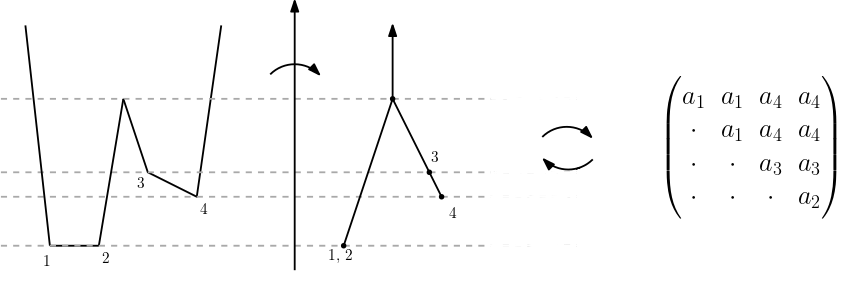 Many applications in science and engineering use scalar functions to describe and model their data (for example, observed parameters in Weather Research and Forecasting). To analyze such data, merge tree becomes an invaluable tool for comparing graph-based topological summaries.
Merge Tree to Analyze Leaf Data
The Leaf Data
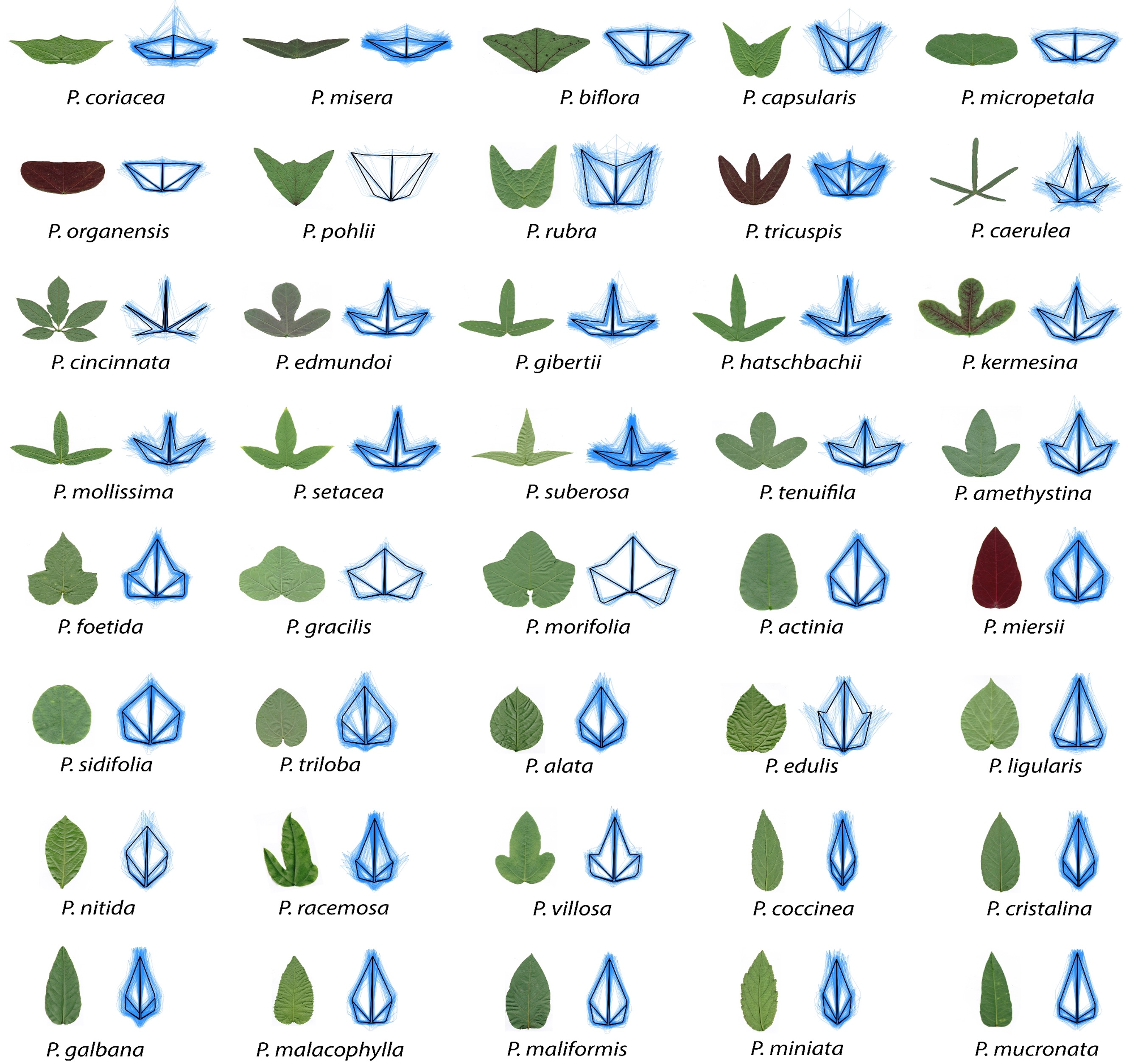
The dataset contains over 3300 scans of the leaves from 40 different species of Passiflora plant. Studying the wide range of leaf shapes offers an intriguing subject of exploration. Finding the `average' leaf shape representing each species is important for leaf morphology study, especially in predicting species identity.
Computing the Merge Tree
There are 15 positional landmarks (the x and y coordinate information) for each leaf in the dataset. Interior landmarks are removed.
Observe that the outline of the leaves is homotopic to cyclic graphs with labels. The merge tree needs to be computed in sufficiently many directions from \(\mathbb{S}^1\), with each cyclic graph preserving the labels.
For this particular dataset, the merge tree is computed in 2 directions, namely the \(x\) and \(y\) directions. This stores ample information about the leaf shape for further analysis.